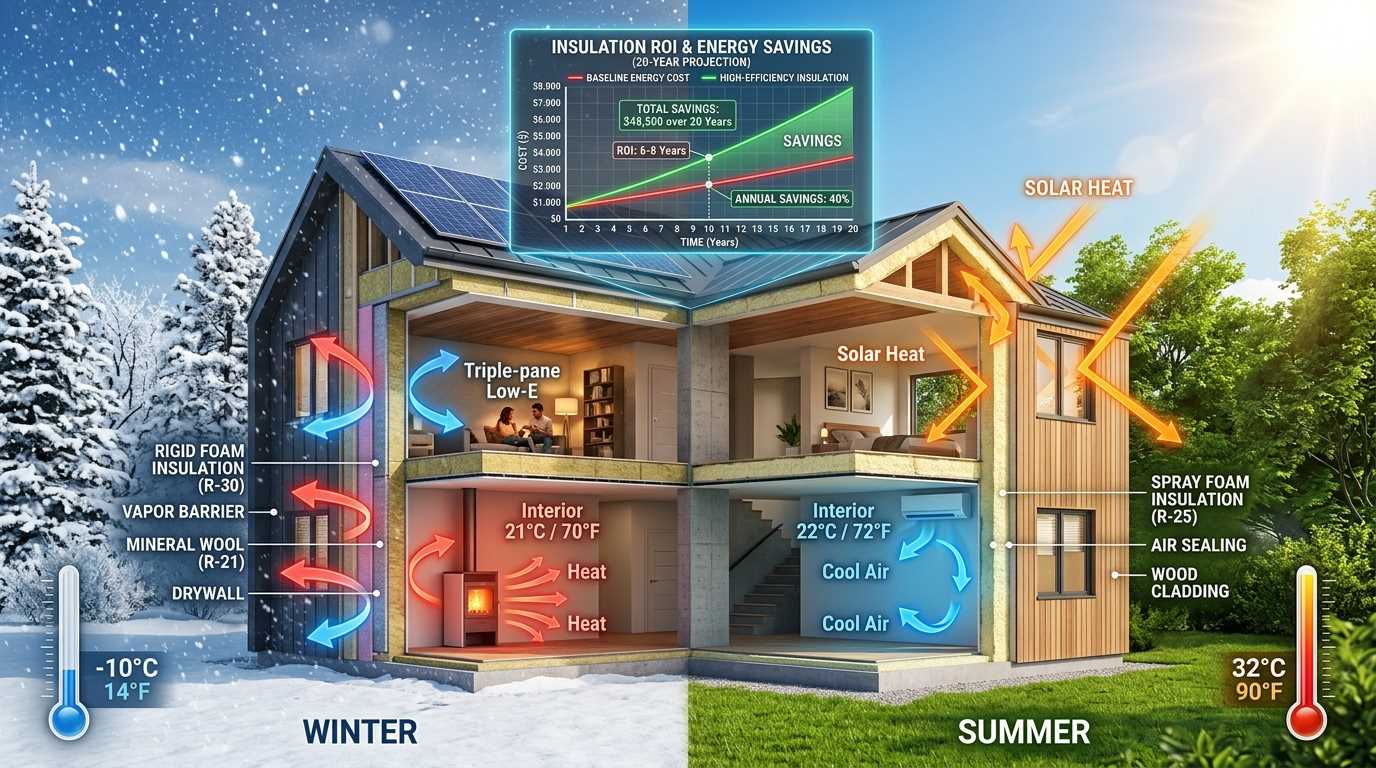
The Insulation Investment Case
I've been doing energy audits since 2019, and insulation upgrades are consistently the second-highest-ROI recommendation I make — right after sealing air leaks, which I'll get to. In fact, insulation and air sealing usually come as a package deal because they work together.
Here's the basic investment thesis: the average American home built before 2000 is under-insulated per DOE standards. Adding insulation reduces heating and cooling energy consumption by 10-25%, depending on climate, current insulation levels, and the area you're upgrading. For a household spending $2,000/year on HVAC, that's $200-$500/year in savings. Run your own numbers through our insulation ROI calculator to get precise estimates.
But the numbers get more interesting when you factor in comfort improvements. I've had clients tell me that the single biggest comfort improvement they ever made was adding attic insulation — not because of the bill savings, but because the second-floor bedrooms finally stopped being ovens in summer and iceboxes in winter. That comfort improvement has real value even if it's hard to put a dollar figure on it.
In 2026, the federal tax credit for insulation upgrades is 30% of the cost, up to $1,200 per year, under the Inflation Reduction Act's 25C credit (IRS). This significantly improves the payback period for most projects.
💡 Key Insight
The DOE estimates that adding proper insulation and air sealing saves an average of 15% on heating and cooling costs — or about 11% of total energy costs. For a home spending $2,400/year on energy, that's $360/year back in your pocket. With the 30% federal tax credit, the effective payback period drops significantly.
Types of Insulation and Costs
There are four main types of insulation used in residential applications in 2026. Each has different costs, performance characteristics, and best-use cases:
- Fiberglass batts (roll insulation): The most common and cheapest option. Costs $0.50-$1.50 per square foot for materials, $1.50-$3.50 per sq ft installed. R-value: R-2.9 to R-3.8 per inch. Best for: new construction, accessible attics, and DIY projects. Downsides: gaps and compression during installation reduce actual performance by 10-30% compared to rated R-value.
- Blown-in fiberglass or cellulose: Costs $1.00-$2.50 per sq ft installed. R-value: R-2.2 to R-3.8 per inch depending on material. Best for: topping up existing attic insulation, filling wall cavities (dense-pack), and irregular spaces. Downsides: settles over time (5-15% over 10 years), requires special blowing equipment for installation.
- Spray foam (open-cell and closed-cell): The premium option. Open-cell: $1.50-$3.50 per sq ft installed. Closed-cell: $3.00-$6.50 per sq ft installed. R-value: open-cell R-3.5-3.8/inch, closed-cell R-6.0-7.0/inch. Best for: cathedral ceilings, rim joists, and areas where air sealing is also needed. Downsides: significantly more expensive, professional installation required, off-gassing concerns during installation.
- Rigid foam board: Costs $2.00-$5.00 per sq ft installed. R-value: R-4.0 to R-6.5 per inch depending on type (EPS, XPS, or polyiso). Best for: exterior wall sheathing, basement walls, and under slab applications. Downsides: must be covered with fire-rated material when installed indoors, labor-intensive to fit around obstructions.
R-Value Explained Simply
R-value measures thermal resistance — how well a material resists heat flow. Higher R-value = better insulation. The number is additive: two layers of R-19 give you R-38 total.
Here's what the DOE recommends for different areas of your home in different climate zones:
- Attic (Zones 1-3, warm climates): R-30 to R-49
- Attic (Zones 4-5, mixed climates): R-38 to R-60
- Attic (Zones 6-8, cold climates): R-49 to R-60
- Walls (all zones): R-13 to R-21 for 2x4 construction, R-19 to R-30 for 2x6 construction
- Floors over unconditioned spaces: R-25 to R-30
- Basement walls: R-10 to R-20
- Crawl space walls: R-10 to R-20
The key insight: adding insulation has diminishing returns. Going from R-0 to R-19 cuts heat flow by 95% (compared to no insulation). Going from R-19 to R-38 only cuts the remaining heat flow by another 50%. So the first layer of insulation you add gives you the biggest bang, and each additional layer gives progressively smaller savings. This matters when deciding how much insulation to add.
"Don't overthink R-value. The DOE's recommendations are well-calibrated. If your attic is at R-10 and the recommendation is R-49, get it to at least R-38. You don't need to hit R-60 for good returns — the last increment costs as much as the first but saves a fraction as much."
Climate Zone Matters
Where you live determines which insulation upgrades are worth doing and how quickly they pay back. The US has 8 climate zones defined by the IECC (International Energy Conservation Code):
- Zones 1-2 (Hot): South Florida, South Texas, Southern Arizona, Hawaii. Cooling dominates. Attic insulation and radiant barriers are the priority. Payback for attic insulation: 4-8 years.
- Zone 3 (Warm): Most of the South, Southern California. Both heating and cooling matter. Attic + wall insulation both pay back well. Payback: 5-10 years.
- Zones 4A-4B (Mixed): Mid-Atlantic, Midwest transition zone, Pacific Northwest. Moderate heating and cooling needs. Good all-around insulation ROI. Payback: 4-8 years.
- Zones 5-6 (Cool/Cold): Most of the Northeast, Upper Midwest, Mountain states. Heating dominates. Insulation pays back fast, especially attic and walls. Payback: 3-6 years.
- Zones 7-8 (Very Cold): Northern Minnesota, Maine, Alaska. Extreme heating needs. Insulation is critical. Payback: 2-5 years.
The pattern is clear: colder climates see faster payback on insulation because heating energy costs more per BTU than cooling energy (heat pumps are efficient but still use electricity, while natural gas heating is cheap in many areas — but electric heating is expensive).
Attic vs Wall vs Floor Insulation
Not all insulation upgrades are created equal. Here's how they rank by ROI:
1. Attic insulation (highest ROI): This is almost always the best first upgrade. Heat rises, so your attic is where the most heat escapes in winter and where the most heat enters in summer. Most homes built before 2000 have R-11 to R-19 in the attic when they should have R-38 to R-60. Adding blown-in cellulose on top of existing batt insulation is straightforward and cheap. Cost for a 1,500 sq ft home: $1,500-$3,000 to go from R-19 to R-49. Savings: $200-$400/year. Payback: 4-8 years. With the 30% tax credit: 3-6 years. For context on how this fits into your overall energy picture, see my guide on calculating your home energy usage.
2. Rim joist insulation (second highest ROI): The rim joist (where your foundation meets your floor framing) is one of the biggest sources of air leakage and heat loss in most homes. It's often completely uninsulated. Spray foam or rigid foam board installed on the rim joist costs $200-$500 for a typical home. Savings: $50-$150/year plus significant comfort improvement. Payback: 2-5 years. This is the best DIY insulation project — it's accessible, small-area, and the impact is immediately noticeable.
3. Basement/crawlspace walls: If your basement is unfinished and uninsulated, adding rigid foam or spray foam to the walls costs $1,500-$4,000. Savings: $100-$250/year. Payback: 8-15 years. Lower ROI than attic, but it also makes the basement more usable, which adds home value beyond energy savings.
4. Wall insulation (lowest ROI for retrofits): Adding insulation to existing walls is expensive because it requires removing siding or drilling holes and dense-packing. Cost: $3,000-$8,000 for a 1,500 sq ft home. Savings: $100-$300/year. Payback: 15-25 years. However, if you're re-siding your home anyway, adding exterior rigid foam during the re-side project is much cheaper and brings the payback down to 8-12 years.
5. Floor insulation over crawlspaces: If your home sits on a crawlspace with no floor insulation, adding batt or rigid foam between floor joists costs $1,000-$3,000. Savings: $100-$200/year. Payback: 7-15 years. This also eliminates cold floors in winter, which is a significant comfort improvement.
The Air Sealing Bonus
Here's the thing that changes everything: insulation without air sealing is like wearing a wool sweater in the wind. The wool is warm, but if the wind blows through it, you're still cold. Insulation works the same way — air moving through it dramatically reduces its effectiveness.
Most homes have 20-40% air leakage through the building envelope. Sealing these leaks with caulk, foam, and weatherstripping costs $200-$600 in materials (or $500-$1,500 professionally) and typically reduces heating and cooling costs by 10-20%. For a home spending $2,000/year on HVAC, that's $200-$400/year in savings. Payback: 1-3 years. Before investing in sealing, use a heating cost calculator to understand your baseline heating expenses.
The critical air sealing targets, in priority order:
- Attic penetrations: Every wire, pipe, duct, and chimney that passes through your attic floor is a hole leaking conditioned air. Seal around each one with expanding foam or caulk. This single task is worth $50-$150/year in most homes.
- Recessed lights in the ceiling: Non-IC-rated recessed lights are essentially holes to your attic. Seal them with airtight covers (IC-rated airtight recessed light covers, $8-15 each) or replace them with LED airtight wafer lights.
- Plumbing and electrical penetrations: Where pipes and wires enter/exit your home through walls and floors. Seal with expanding foam. $5-$10 per can of Great Stuff, $30-$80/year in savings.
- Window and door gaps: Weatherstripping and caulking. $50-$150 for a whole home. $50-$150/year in savings. Payback: about 1 year.
- Duct leaks: If your ducts run through unconditioned spaces, sealing them with mastic saves $80-$200/year. Professional duct sealing costs $300-$800.
🔧 Pro Tip
- Always air seal BEFORE adding insulation. Sealing after insulating means you have to dig through your new insulation to find the gaps. Seal first, then insulate on top.
- Use a blower door test to find your biggest air leaks. The depressurization makes leaks obvious — you can feel them with your hand. Many energy auditors offer blower door tests for $150-$300.
Payback Periods by Upgrade Type
Here's a summary table of typical payback periods for a 1,500 sq ft home in a mixed climate (Zone 4) with electric heating/cooling and $0.172/kWh rates:
- Air sealing (whole house): Cost $300-$800. Savings $200-$400/year. Payback: 1-3 years.
- Attic insulation (R-19 to R-49): Cost $1,500-$3,000. Savings $200-$400/year. Payback: 4-8 years (3-6 years with 30% tax credit).
- Rim joist insulation: Cost $200-$500. Savings $50-$150/year. Payback: 2-5 years.
- Crawlspace floor insulation: Cost $1,000-$3,000. Savings $100-$200/year. Payback: 7-15 years.
- Basement wall insulation: Cost $1,500-$4,000. Savings $100-$250/year. Payback: 8-15 years.
- Exterior wall insulation (during re-side): Cost $3,000-$8,000. Savings $100-$300/year. Payback: 10-25 years.
- Spray foam roof deck (cathedral ceiling): Cost $3,000-$7,000. Savings $200-$500/year. Payback: 8-15 years.
Notice the pattern: air sealing and attic insulation are the clear winners. Everything else is worthwhile in specific situations but doesn't have the universal appeal of those two.
Getting Professional Quotes vs DIY
Insulation is one of those home improvements where DIY is genuinely viable for some tasks but not others:
Good DIY projects: Blown-in attic insulation (you can rent a blower from Home Depot for free with material purchase), rim joist foam board installation, weatherstripping and caulking, floor insulation between joists. Total DIY savings: 40-60% vs. professional installation.
Worth hiring a pro: Spray foam application (requires specialized equipment and training, plus safety gear for chemical exposure), dense-pack wall insulation (requires special equipment to drill and fill wall cavities), exterior rigid foam during re-siding (best done alongside the siding contractor).
When getting professional quotes, always get at least three. Ask each contractor to specify: the R-value they're installing, the square footage being covered, the material type, and whether air sealing is included. A proper insulation quote should itemize these components. If a contractor gives you a single lump-sum number without specifying R-value, they're either being vague about what you're getting or they don't understand the science themselves.