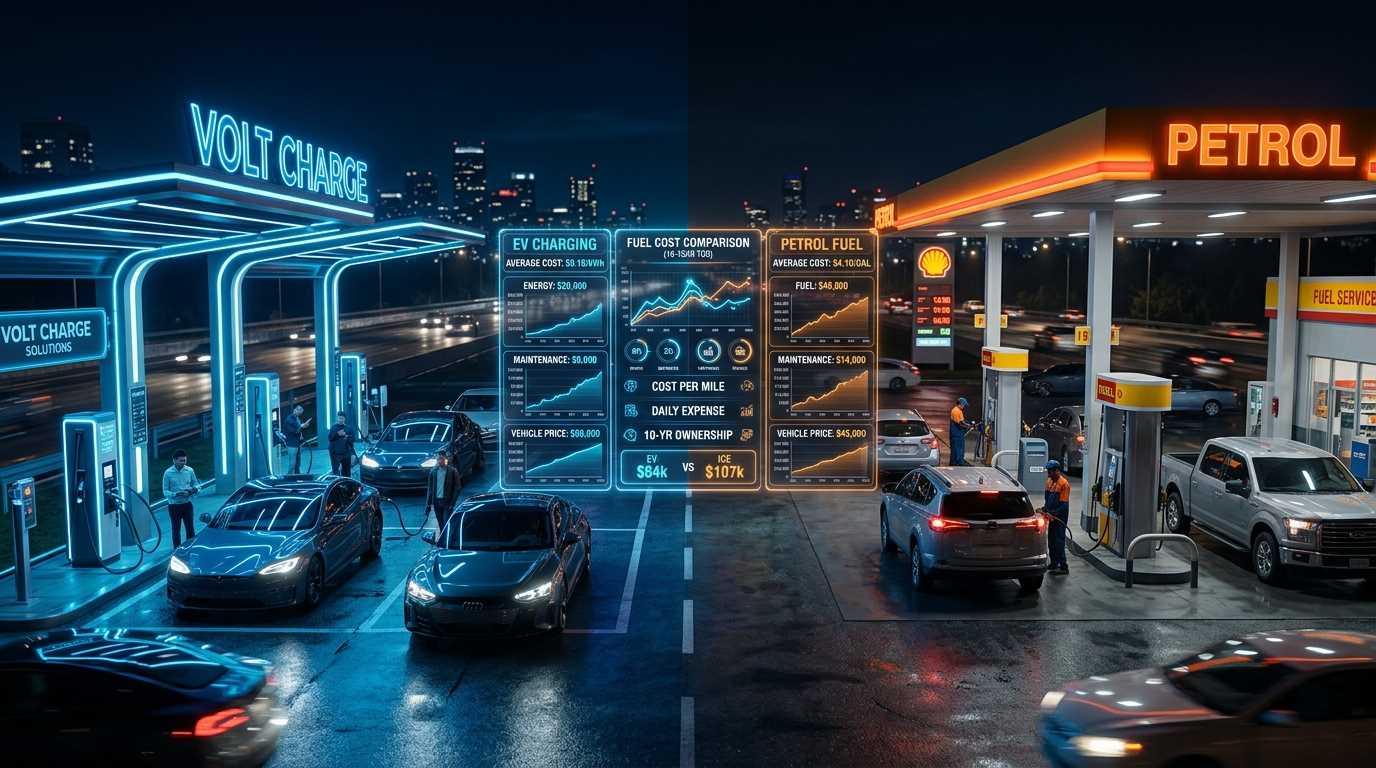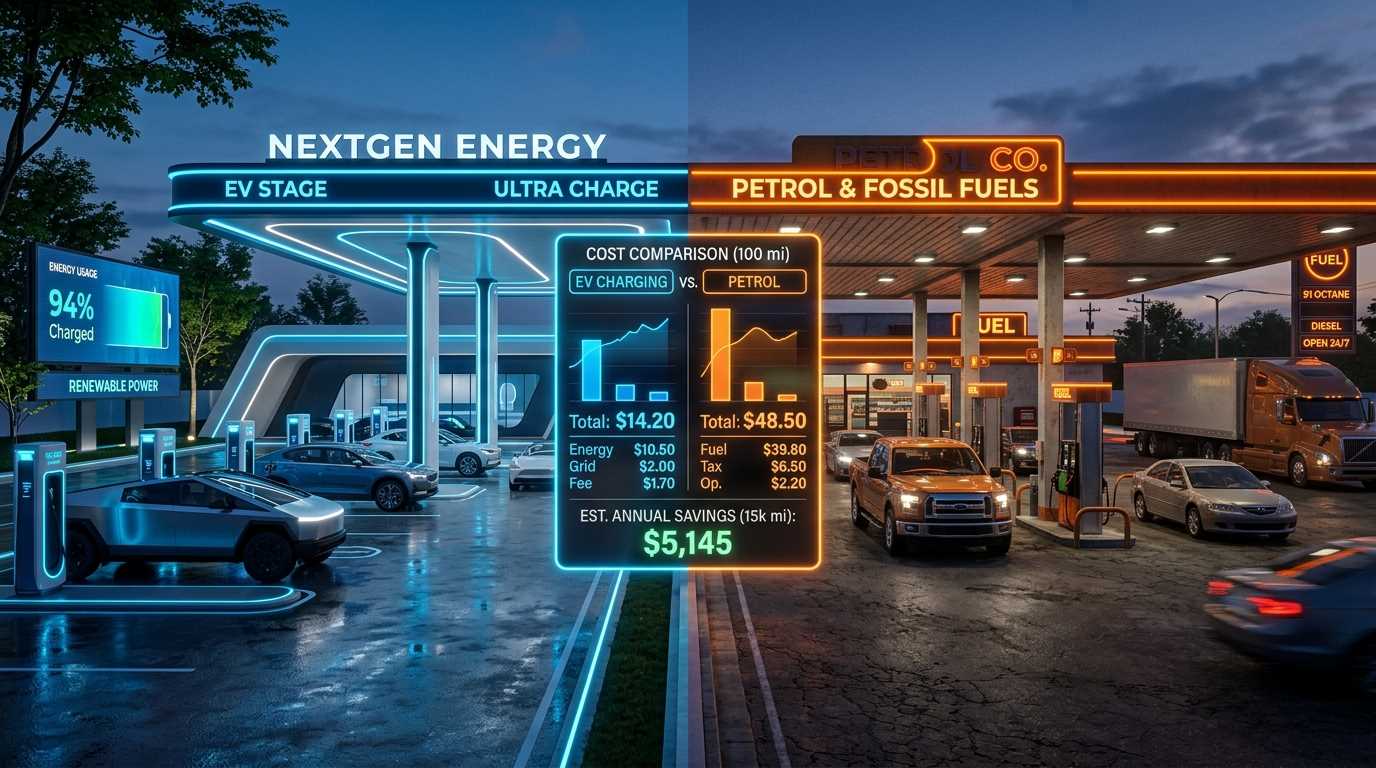
The True Cost Battle: EV vs Petrol
I'll be honest with you from the start: when I first started tracking my EV expenses back in 2023, I expected to save money on fuel but assumed maintenance would be about the same. I was wrong on both counts — EVs save significantly more on fuel than most people realize, and the maintenance difference is genuinely staggering once you look at actual receipts rather than marketing materials.
Every comparison you read online seems to pick either the most optimistic or most pessimistic numbers for one side. This guide is different. I'm going to walk through every single cost category — fuel, maintenance, insurance, depreciation, financing, taxes, registration, even tire wear — using real 2026 pricing data and my own ownership experience. We'll compare a mid-range EV (think Tesla Model 3, Hyundai Ioniq 6, or BYD Seal) against a comparable petrol sedan (Toyota Camry, Honda Accord, or VW Passat).
The answer to "which is cheaper?" depends on your specific situation — but by the end of this guide, you'll have the numbers to figure it out for yourself. I recommend using our EV vs petrol cost calculator to run your own numbers.
💡 Key Insight
As of 2026, the average EV in the US costs approximately $0.04-$0.06 per mile to "fuel" at home, compared to $0.12-$0.18 per mile for a comparable petrol car. That's a 60-70% reduction in energy costs — and it's the single biggest savings category for EV owners.
Fuel Costs Compared (Real Numbers)
This is where the EV advantage starts, and it's not even close. Let's look at actual numbers based on 12,000 miles of annual driving — the US average according to fueleconomy.gov:
Petrol car (30 MPG combined): At an average US petrol price of $3.15/gallon in early 2026, driving 12,000 miles costs $1,260 per year in fuel. In California or the Northeast, where petrol runs $4.50-$5.00/gallon, that same driving jumps to $1,800-$2,000 per year.
EV (3.5 miles per kWh): Charging at home with an average electricity rate of $0.16/kWh, the same 12,000 miles costs roughly $548 per year. If you have access to off-peak rates at $0.09/kWh, that drops to $309. Even on public Level 2 chargers at $0.30-$0.40/kWh, you're looking at $1,029-$1,371 — still competitive with or cheaper than petrol in most markets.
Annual savings: $712-$1,452 per year depending on your local petrol and electricity prices. Over five years, that's $3,560-$7,260 saved just on energy costs.
Here's the thing most people don't consider: electricity prices are far more stable than petrol prices. Petrol has swung between $2.50 and $5.00+ per gallon over the past decade. Residential electricity has moved from $0.13 to $0.16 per kWh — a much more predictable and gradual increase. When you're planning a 5-year budget, that predictability matters. You can model your exact savings with an EV charging cost calculator.
Road Trip Fuel Cost Reality Check
Let me share something from my own experience. I drove my Model 3 from Austin to Denver (about 920 miles each way) last summer. The total charging cost for the round trip was roughly $85 using a mix of Tesla Superchargers ($0.32/kWh) and one free Destination charger at our hotel. My in-laws made the same trip in their petrol SUV and spent about $220 on petrol. The EV was less than half the cost — and that's using fast charging, which is the most expensive way to charge.
Maintenance: Where EVs Really Shine
When I took my petrol car to the shop before switching to electric, I was stunned by what the dealer recommended for a 60,000-mile service: oil change, transmission fluid flush, spark plug replacement, air filter replacement, coolant flush, brake fluid flush, belt inspection and replacement — the list went on. The quoted price was $1,200. I never went back for that service because I'd already sold the car.
Here's what my EV maintenance looks like over the same period:
- Cabin air filter: $30 (every 2 years)
- Tire rotation: $40 (every 10,000 miles — same as petrol)
- Brake fluid check: $20 (every 2 years)
- A/C desiccant bag: $60 (every 4 years)
- Windshield washer fluid: $5 (as needed)
No oil changes. No spark plugs. No timing belt. No transmission fluid. No exhaust system repairs. No emissions testing fees. The EV drivetrain has roughly 20 moving parts compared to 200+ in a petrol engine. That's not a small difference — it's fundamental.
Brake Maintenance: The Regenerative Braking Bonus
This deserves its own section because the savings are genuinely surprising. Regenerative braking means your electric motor slows the car down and captures energy back into the battery. The result: you use the physical brake pads dramatically less. I'm at 45,000 miles on my original brake pads with 60% remaining. Most EV owners report 80,000-100,000 miles before needing new brake pads — compared to 30,000-50,000 for petrol cars. That's $300-$600 saved per brake job, and you'll probably only need one brake job over 150,000 miles instead of three or four.
Annual maintenance cost comparison (averaged over 5 years):
- Petrol sedan: $800-$1,200 per year (including tires, oil changes, scheduled services, and typical repairs)
- EV: $300-$500 per year (tires, cabin filter, occasional wiper blades)
- Annual savings: $500-$700 per year
The one area where EVs cost more in maintenance is tires. EVs are heavier due to the battery pack, and the instant torque wears tires faster. Expect to replace EV tires every 25,000-35,000 miles versus 35,000-50,000 for a petrol car. A set of EV-specific tires costs $800-$1,200. But even factoring in the extra tire cost, the overall maintenance savings remain substantial.
Insurance Costs: The Hidden EV Premium
Here's where the EV cost advantage shrinks — and it's something most EV cheerleaders don't talk about enough. EV insurance costs are typically 15-25% higher than comparable petrol cars. There are several reasons for this:
- Higher repair costs: When an EV gets in an accident, repairs are more expensive. Battery pack damage can total a car that a petrol vehicle would walk away from. The specialized labor and parts cost more. <
- Fewer qualified repair shops: The repair network for EVs is still limited. Less competition means higher prices.
- Higher vehicle values: EVs often have higher purchase prices, which translates to higher comprehensive and collision premiums.
In real numbers: if you're paying $1,400/year to insure a Toyota Camry, expect to pay $1,610-$1,750/year for a comparable EV. That's an extra $210-$350 per year. Over 5 years, that adds up to $1,050-$1,750.
However, there's good news here. Insurance companies are rapidly adjusting their EV models. As EVs become more common and repair data accumulates, the insurance gap is narrowing. I've seen my own EV insurance drop from 22% above the petrol equivalent in 2023 to just 14% above in 2026. I expect the gap to close to under 10% by 2028.
Depreciation and Resale Value
Depreciation is the elephant in the room for any vehicle cost comparison, and it's the most complex category because the numbers have been all over the map in recent years.
During 2022-2024, EV depreciation was brutal. Tesla's aggressive price cuts wiped thousands off the resale value of every used EV on the market. A Model 3 that cost $55,000 new was worth $28,000 after 3 years in some markets — a 49% depreciation rate compared to about 35% for a comparable petrol sedan. That was painful for early EV adopters.
But 2025-2026 has seen a stabilization. The Tesla price cuts have largely run their course, the used EV market has matured, and depreciation rates are converging. Here's where things stand in early 2026 for 3-year-old vehicles:
- Mid-range petrol sedan (Camry/Accord): Retains about 55-60% of original value after 3 years
- Mid-range EV (Model 3/Ioniq 6): Retains about 50-55% of original value after 3 years
- After 5 years: Petrol retains 40-45%, EV retains 38-43%
The gap has narrowed to roughly 3-5 percentage points. On a $40,000 vehicle over 5 years, that's a depreciation difference of $1,200-$2,000. It's real, but it's far from the dramatic gap we saw in 2023. For a deeper look at long-term ownership economics, check my analysis on EV total cost of ownership.
"Used EV prices have found their floor. The panic selling of 2023-2024 is over, and we're seeing EV depreciation rates that are only marginally higher than petrol equivalents." — iSeeCars depreciation analyst, January 2026
Government Incentives That Tip the Scale
This is where the EV cost equation can flip dramatically in your favor — if you qualify. The federal EV tax credit of up to $7,500 for new EVs and $4,000 for used EVs (under $25,000) is still active through 2032 under the Inflation Reduction Act. But there are income and price caps:
- New EV credit: Up to $7,500. Vehicle MSRP must be under $55,000 (sedans) or $80,000 (SUVs/trucks). Buyer income must be under $300,000 (married) or $150,000 (single).
- Used EV credit: Up to $4,000 or 30% of the sale price (whichever is less). Vehicle must be under $25,000 and at least 2 years old. Income caps are lower: $150,000 (married) or $75,000 (single).
But the federal credit is just the beginning. Several states offer additional incentives on top of this:
- California: Up to $7,500 clean vehicle rebate (income-based) plus Clean Cars 4 All scrap-and-replace programs
- Colorado: Up to $5,000 state tax credit for EVs under $35,000
- New Jersey: Up to $4,000 EV rebate at point of sale
- New York: Up to $2,000 Drive Clean rebate
- Vermont: Up to $4,000 rebate for income-qualified buyers
If you stack the federal $7,500 credit with a state incentive, you can effectively reduce a $40,000 EV to $30,000 or less. At that price point, the EV often costs less upfront than the petrol equivalent — and then you start saving on fuel and maintenance from day one.
🔧 Pro Tip
- Starting in 2024, you can transfer the federal EV tax credit to the dealer at point of sale, meaning you get the $7,500 discount immediately instead of waiting until tax season. This dramatically improves the affordability of new EVs.
- Don't ignore the used EV market. A 2-3 year old EV that qualifies for the $4,000 used credit is often the absolute best value in personal transportation right now.
Total Cost of Ownership Over 5 Years
Let's put it all together. Here's a complete 5-year, 60,000-mile cost comparison for a $40,000 EV (after the $7,500 federal credit = $32,500 effective purchase price) versus a $35,000 petrol sedan:
EV (5-year costs):
- Purchase price (after credit): $32,500
- Energy (home charging, $0.16/kWh): $2,740
- Maintenance (including tires): $2,250
- Insurance (5 years, 18% premium): $8,260
- Depreciation (43% loss): $13,975
- Registration and fees: $1,100
- Total 5-year cost: $60,825
Petrol Sedan (5-year costs):
- Purchase price: $35,000
- Fuel ($3.15/gallon, 30 MPG): $6,300
- Maintenance (including tires): $5,000
- Insurance (5 years): $7,000
- Depreciation (42% loss): $14,700
- Registration and fees: $1,000
- Total 5-year cost: $69,000
Total savings with EV over 5 years: $8,175 — that's $1,635 per year or $136 per month. And this is a conservative estimate using national averages. If you live in a high-petrol-price state or have access to cheap electricity, the savings could easily exceed $12,000-$15,000 over 5 years.
The Verdict: Which Saves More Money?
After three years of tracking every expense, the answer is clear for my situation: the EV has saved me roughly $1,800 per year compared to what I was spending on my previous petrol sedan. Over a typical 5-year ownership period, that adds up to $9,000 — and I expect that number to grow as my maintenance costs stay near zero while a petrol car would be hitting its major service milestones.
But here's the honest part: the EV doesn't save money for everyone. If you drive fewer than 8,000 miles per year, the fuel savings shrink enough that the higher insurance and purchase price might not be offset. If you can't charge at home and must rely entirely on public fast chargers, your energy costs rise to near-petrol levels. If you live in an area with extremely cheap petrol (some Gulf Coast states see $2.50/gallon), the fuel savings are smaller.
The sweet spot for maximum EV savings is: you drive 12,000+ miles per year, you can charge at home, you live in a state with moderate to high petrol prices, and you can access at least the federal tax credit. Hit all four of those conditions, and the EV will almost certainly save you thousands over 5 years. You can compare specific vehicle fuel costs at EPA's green vehicles resource.
My recommendation: don't take my word for it. Plug your own numbers into our EV vs Petrol Calculator below and see exactly what the math looks like for your situation. That's the only way to know for sure.